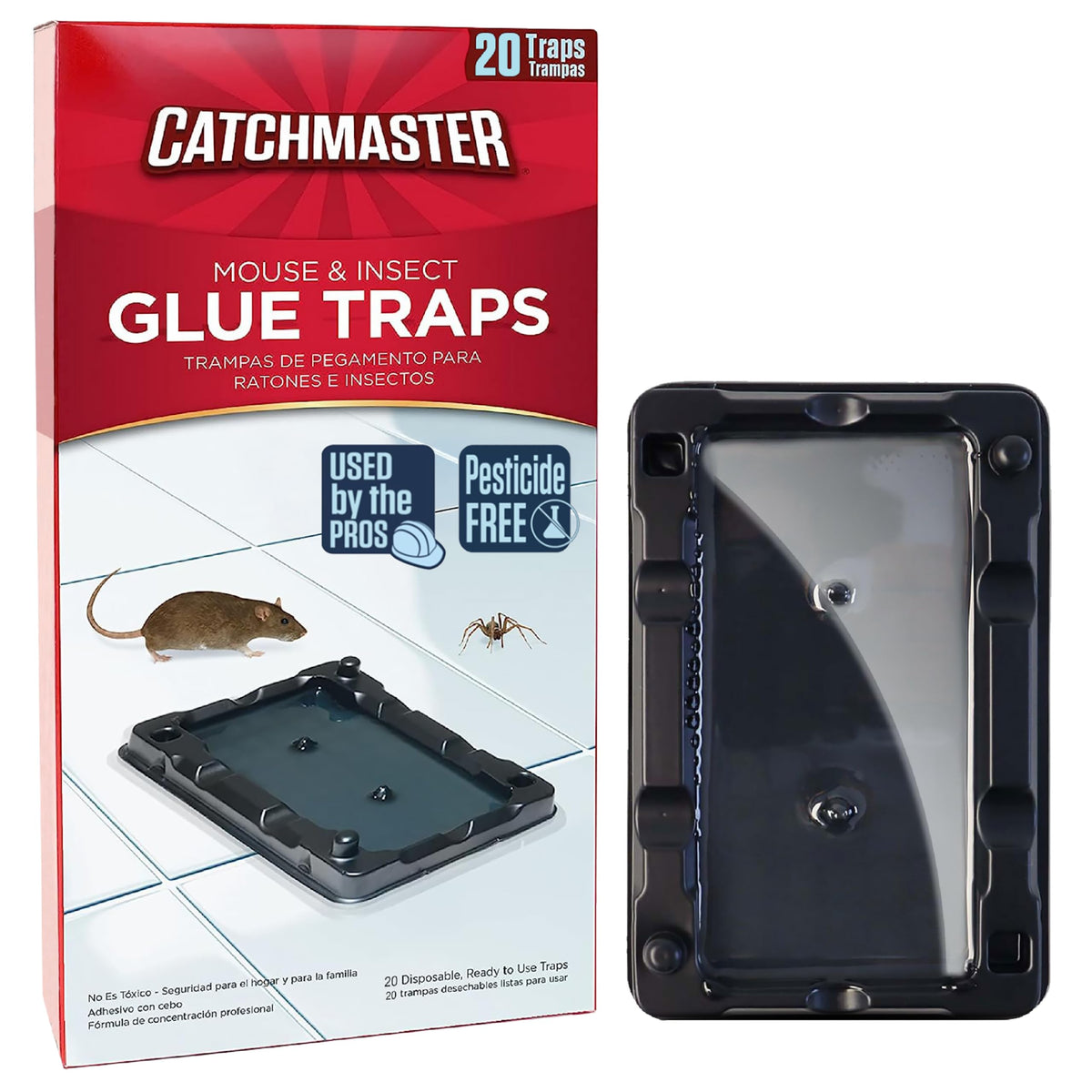
Catchmaster Sticky Mouse Traps – Humidity-Resistant Adhesive Boards for Bathroom, Basement, and Pantry Pest Control, Indoor Rodent and Bug Catcher
Catchmaster Sticky Mouse Traps – Humidity-Resistant Adhesive Boards for Bathroom, Basement, and Pantry Pest Control, Indoor Rodent and Bug Catcher
Couldn't load pickup availability
Why you'll love it
- Pesticide-free glue means safer deployment around children, pets, and food prep areas than chemical rodenticides
- Up to one full year of effectiveness in normal conditions means fewer replacements and lower long-term cost
- Dual-purpose design catches both rodents and crawling insects, replacing the need to buy separate traps
- Low-profile 0.32-inch height fits under furniture and inside tight gaps where pests travel but bulky traps won't go
- Pro-grade reliability trusted by professional exterminators, giving DIY buyers confidence in results
- Suitable for damp basements and bathrooms where other glue boards curl up and fail
- Works in sub-freezing temperatures (0°F, 20s°F, upper 20s°F)
- Thick glue prevents escape
- Lighter color makes dead mice easier to see
- Added height on sides keeps rodents out
- No scent or mess
- Caught mice in less than one hour
- Caught large rats successfully
- Peanut butter works as effective bait
Perfect for
- Capturing mice and crawling insects (roaches, crickets, spiders) along baseboards and wall pathways in residential homes
- Long-term pest monitoring in damp basements, bathrooms, and garages where humidity shortens other traps' lifespan
- Pest control in commercial and industrial buildings where rodenticides or snap traps are restricted or unsafe
- Quick, low-profile deployment in narrow gaps behind appliances, under sinks, and inside cabinets
- Bulk placement across a large home or facility using the 32- or 40-pack variants for full property coverage
- Outdoor use at 0°F
- Meat cooler/commercial refrigeration use
- Garage rodent control in cold weather (New England, Michigan)
- Shed rodent control
- Attic rodent control in 30-45°F temperatures
About this item
READY TO USE: Mouse, Rodent and Insect glue traps are pre-scented and are intended for use without additional mouse bait. For best use, leave the mouse trap with paper on so pests can acclimate to the trap, then place the mouse and bug sticky traps along known or suspected rodent pathways. The traps are scented with a special formula to attract insects and mice.

YEAR-ROUND PROTECTION: Catchmaster glue traps for mice are safe, non-toxic and mess-free. The insect and mice traps are an effective alternative to standalone glue boards that may not hold up as well in damp or humid areas like basements or bathrooms. When placed in an area with normal conditions, mouse traps indoor for home can last up to one full year.

HOME & FAMILY SAFE: Designed to help you keep your family protected and safe from unwanted pests in your home, the indoor bug catcher and mouse trap is intuitive, secure and effective. Our mouse glue trap is easy to place, simply put the mouse traps indoor against walls & along pathways to catch unwanted pests and insects.

TOTAL COVERAGE: Use the mouse and bug catcher indoor in residential, commercial, or industrial buildings, and sensitive areas where rodenticides or snap traps are undesirable or prohibited. The mouse and insect traps indoor are designed to fit in narrow spaces to optimize pest control coverage. Our glue boards are proudly made in the USA, fast acting and non-toxic, keeping your family and home safe from pests!

INTELLIGENT PEST MANAGEMENT: At our core, we are dedicated pest detectives. We believe in utilizing a science-based approach to integrated pest control. We call this approach Intelligent Pest Management. We leave no stones unturned when it comes to pests and we have unwavering conviction in our products.

Frequently Asked Questions
Will Catchmaster glue traps work in my damp basement?
Yes. Catchmaster traps are specifically engineered with humidity-resistant construction that maintains adhesive strength in damp basements, bathrooms, and garages for up to 12 months. Many other glue boards curl up, lose tack, or fail entirely in humid environments, but Catchmaster holds its grip even in musty basement utility rooms and laundry areas.
How many traps do I need for a whole house?
Most pest control professionals recommend placing traps every 6 to 10 feet along walls and baseboards in areas of activity. For an average single-family home, the 16-pack or 20-pack covers a typical kitchen, basement, garage, and pantry. For larger homes, multi-unit properties, or full-facility coverage, the 32-pack or 40-pack provides the best value and complete coverage.
Do I need to use bait on these glue traps?
No bait is required. The traps are pre-engineered to capture mice and crawling insects as they travel along walls and baseboards. Many customers do add a small dab of peanut butter in the center as an attractant, and report that it works very well, but the heavy-duty adhesive is effective on its own.
Can I use these in my kitchen and pantry?
Yes. The pesticide-free, scent-free design makes Catchmaster traps ideal for kitchens, pantries, and food storage areas where rodenticides and chemical baits are not acceptable. Place them along baseboards, behind the refrigerator, under the sink, and beside the pantry wall to intercept mice where they enter.
Are these traps low-profile enough to fit under my refrigerator and oven?
Yes. The board is just 0.32 inches thin, making it one of the lowest-profile traps on the market. It slides easily under most refrigerators, ovens, dishwashers, and washing machines, capturing the mice that travel through the gap between the appliance and the wall.
Will these traps last a full year without replacing?
Under normal indoor conditions, Catchmaster traps maintain their adhesive strength for up to 12 months. In dry, climate-controlled rooms they can remain effective for a full year, making them an excellent long-term monitoring tool and a cost-effective replacement for short-lived glue boards.
How do I place the traps for the best results at home?
Slide the trap flush against the wall with the adhesive surface facing the wall, since mice and roaches travel along edges rather than across open floor. Place boards every 6 to 10 feet along baseboards, behind appliances, under the kitchen sink, and in corners where you have seen droppings or activity.
Will the lighter color really help me see what I caught?
Yes. The lighter-colored board design improves visibility of catch significantly compared to traditional dark or yellow glue boards. Customers specifically mention that the lighter color makes it much easier to confirm a catch and to know when the trap needs to be replaced.
Can I use these in a rental apartment where snap traps are not allowed?
Yes. Catchmaster glue traps are popular with apartment dwellers and renters specifically because most lease agreements that prohibit snap traps and rodenticides do allow pesticide-free adhesive boards. They leave no marks on walls or floors and are easy to deploy discreetly in closets, under sinks, and behind appliances.
Are the raised side walls important?
Yes. The added side-wall height on Catchmaster traps is a key feature that prevents mice from simply stepping over the glue and continuing on. The raised edges channel rodents directly into the adhesive, which is one of the reasons professional exterminators trust this design for reliable capture.
I only have a small mouse problem. Which pack size is right?
For a single mouse sighting in one or two rooms, the 6-pack or 8-pack is plenty. Place two or three traps in the active room and a couple in adjacent rooms to catch any mice traveling between spaces. Many customers start with a small pack and reorder the larger 32-pack or 40-pack once they confirm activity.
Do these work on roaches and spiders too, or just mice?
Catchmaster traps are dual-purpose and effectively capture mice, rats, roaches, crickets, spiders, and other crawling insects. The same heavy-duty adhesive works on small and large pests, so one board replaces the need to buy separate mouse traps and bug traps.
How long does it take to catch a mouse once placed?
Many customers report catching mice in less than one hour after deployment, especially when the trap is placed along a known travel path with a small dab of peanut butter bait. Even in low-activity homes, most catches happen within 24 to 48 hours of placement along baseboards or behind appliances.
Will these work in my garage during a New England winter?
Yes. The cold-weather formulation is engineered specifically for unheated garages, sheds, and attics in sub-freezing temperatures. Customers in New England, Michigan, and other northern climates confirm reliable capture in upper 20s°F and down to 0°F, while other glue boards freeze and fail.
Are these safe to use around a meat cooler or commercial refrigerator?
Yes. Catchmaster traps are widely used in commercial kitchens, meat coolers, and refrigeration units because they are pesticide-free, scent-free, and produce no fumes. The humidity-resistant construction also holds up in cold, damp cooler environments where other glue boards lose tack.
What's the difference between the standard pack and the cold-weather variant?
The cold-weather variant (B084H1TJ57) uses a specially formulated adhesive that stays tacky in sub-freezing temperatures, making it the right choice for unheated garages, sheds, attics, outdoor storage, and northern winter use. The standard packs are humidity-resistant and work in all indoor temperatures above freezing. If your garage or shed drops below 32°F, choose the cold-weather pack.
How do I set up a Catchmaster glue trap?
Catchmaster traps come pre-adhesive and ready to use. Simply slide the low-profile board flush against the wall with the adhesive surface facing the wall, since mice and roaches travel along edges rather than across open floor. For best results, place traps every 6 to 10 feet along baseboards, behind appliances, under sinks, and in corners where you have seen droppings or other activity. A small dab of peanut butter can be added to the center as bait, but it is not required.
How do I dispose of a trap after a catch?
Wear gloves or use a plastic bag to lift the trap, fold the board closed with the catch sealed inside, and place it in a sealed bag before putting it in the trash. Because the trap is pesticide-free, there are no chemical disposal requirements. Many customers find the fold-and-dispose method clean and mess-free, with no smell or residue.
How often should I check the traps?
In active infestations, check traps every 24 to 48 hours. For long-term monitoring in basements, garages, and utility rooms, weekly checks are sufficient. The 12-month effectiveness means boards can remain in place for ongoing monitoring between inspections without losing adhesive strength.
Will these traps work on large rats or just mice?
Catchmaster traps have been successfully used to catch large rats as well as mice. The thick, heavy-duty adhesive and raised side walls are designed to hold both, and many customers report successful rat captures on the standard board. For very large rats, use multiple boards together to increase the adhesive surface area.
Do these traps fit in narrow gaps behind appliances?
Yes. The compact 5.19-inch by 3.4-inch board is just 0.32 inches thin, making it one of the lowest-profile traps available. It slides easily into the narrow gap between refrigerators, ovens, and dishwashers and the wall, where mice and roaches travel but bulkier traps cannot fit.
What comes in the box?
Each pack contains the selected number of pre-adhesive glue boards, ready to use straight out of the package. No bait, no setup, and no additional hardware are required. Depending on the pack size ordered, you will receive 6, 8, 16, 20, 32, or 40 traps in a single package.
Are these traps safe for long-term indoor use?
Yes. The pesticide-free adhesive and durable USA-made plastic construction are designed for up to 12 months of indoor use in normal conditions. Many customers leave the same boards in place along basement and garage baseboards for a full year as a low-maintenance monitoring and capture solution.
What if the trap gets dusty and loses stickiness?
In dry indoor environments, the adhesive stays tack for up to 12 months. If a board collects significant dust or debris, simply replace it with a fresh one from your multi-pack. The low cost per board means routine replacement is an affordable part of any pest control plan.
What is the difference between glue traps and snap traps?
Glue traps use a heavy-duty adhesive surface to capture and hold pests, with no moving parts, no spring mechanism, and no poison. Snap traps use a spring-loaded bar to kill the rodent instantly. Glue traps are often preferred in homes, apartments, food prep areas, and rental properties because they are pesticide-free, quieter, easier to deploy, and acceptable in places where snap traps and rodenticides are prohibited. They also serve as both a capture and a monitoring tool, since a fresh catch indicates active rodent presence.